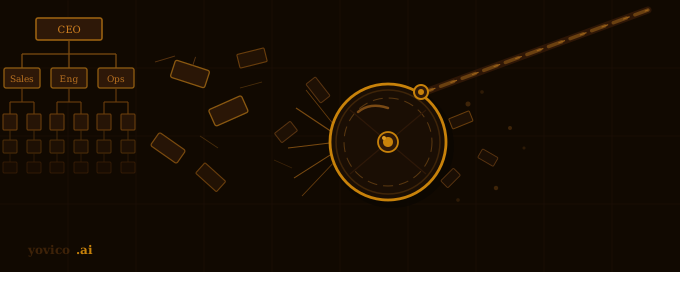
There is a type of person who thrives when the technology stops being interesting.
Not the builder. Not the architect. The person who arrives after the architecture is done, when the hard problems have been solved and what remains is the management of what exists. They are good at meetings. They are good at decks. They are very good at making the absence of progress look like a roadmap.
The startup industry produced an entire professional class of these people between roughly 2001 and 2022. Understanding why tells you something important about what is happening now.
The twenty-five year intermission
The late 1990s were a period of genuine architectural invention. TCP/IP, HTTP, the browser, SSL, the relational database at scale, the distributed file system. These were not incremental improvements. They were foundational structures that did not exist before and that everything built afterward would rest on.
When that phase ended, something predictable happened. The technology became infrastructure. Infrastructure gets optimised, not reinvented. And optimising infrastructure is, fundamentally, a management problem rather than an engineering one.
So the industry produced managers. An entire ecosystem of them. Product managers whose job was to translate engineering into business language. Chief Revenue Officers whose job was to extract margin from products that were good enough. Chief Operating Officers whose job was to install process around things that had previously run on judgment and instinct. Consultants who packaged the resulting activity into frameworks that could be sold to the next company.
This was not corruption. It was rational adaptation to the actual problem, which was no longer invention but distribution and optimisation. The trouble is that rational adaptation to a stable environment produces institutions that are specifically bad at responding to an unstable one.
What social media actually was
Social networks were not a technological breakthrough. They were an application of existing protocols to a new object: human attention.
Facebook did not invent anything that Tim Berners-Lee's infrastructure did not already support. What it invented was a business model for monetising the time people spent staring at screens. The underlying technology was boring. The psychology was not.
This matters because the entire period from roughly 2004 to 2022 that looked like a technology boom was, technically speaking, an attention boom. The hard engineering problems had been solved. What was being competed over was not computational advantage but behavioural capture.
You can win a behavioural capture competition without understanding how a database works. You cannot win a computational architecture competition without it. The two eras select for completely different kinds of people.
The startup industry spent twenty years selecting for people who were good at the wrong thing. Now the thing has changed.
The return of hard problems
Large language models are not an incremental improvement on search. They are not a better database. They are not social media with a different interface.
They are the first genuinely new computational primitive since the web browser. The rules of what is possible have changed in ways that are not yet fully understood, including by the people building with them.
This is what makes the current moment different from the previous twenty years. When technology is genuinely uncertain, the person who does not understand it becomes dangerous rather than merely inefficient. A product manager who cannot reason about context windows, inference costs, and retrieval architecture is not just adding overhead. They are making decisions that will determine whether the product works at all.
The managerial class that accumulated during the long plateau is not equipped for this. Not because those people are unintelligent but because they were optimised, very rationally, for a completely different environment.
One person, serious money
Something strange has been happening at the edges of the technology industry for the past few years, largely ignored by the institutional press because it does not fit the narrative of how startups are supposed to work.
Individual developers are building products used by millions of people with no employees, no investors, and no process. Pieter Levels runs multiple profitable internet businesses generating millions in annual revenue. He does not have a product manager. He does not have a chief revenue officer. He has a laptop and an opinion about what to build.
Andrey Azimov spent a year building products in public, one per month, to see what stuck. No team. No sprint planning. No stakeholder alignment. Sahil Lavingia built Gumroad to tens of millions in revenue, then deliberately contracted back to a tiny team when he realised that growth had made the company slower without making it better.
These are not anomalies. They are early signals of a structural shift in what it costs to build a functioning business. The cost of software has collapsed. The cost of customer acquisition, for a product that genuinely solves a problem, is falling. The cost of infrastructure is variable and low until you have the revenue to justify it.
What has not fallen is the cost of coordination. Every person you add to a company is a coordination surface. Every meeting is coordination overhead. Every process document is an attempt to encode judgment that should not need to be encoded if you hired people with judgment.
The obvious objection is that one-person companies cannot scale. This is sometimes true and often overstated. More importantly, it misses the point. The question is not whether a solo founder can build a billion-dollar company alone. The question is whether the first five years of building that company require the overhead that the previous generation assumed they did.
They do not. Not anymore.
What you actually need versus what companies think they need
A founding team in 2025 needs to do things that previous generations of founders genuinely required other people to do. Market research. Competitive analysis. Customer discovery. Strategic pressure-testing. Financial modelling. The kind of adversarial questioning that stops you building the wrong thing with great execution.
The traditional answer was to hire for these functions, or to pay consultants, or to assemble a board of advisors who would show up quarterly and ask uncomfortable questions for two hours before going back to their day jobs.
These answers were never very good. Hiring is slow and expensive and produces people whose incentives are not aligned with brutal honesty. Consultants charge for frameworks rather than insight. Advisors are distracted and often conflict-averse.
What you actually want is a room full of people who understand your business deeply, have no political stake in any particular answer, and will tell you what they actually think rather than what they calculate you want to hear. You want the CRO who will tell you the ICP is wrong. You want the analyst who will tell you the TAM is half what the deck claims. You want the customer who will tell you the product does not fit the workflow regardless of how elegant the engineering is.
This is what Yovico is. Not a chatbot. Not a research tool. A simulation of the conversations that actually determine whether a company survives its first three years.
Against ossification
The document that seeds this post uses the Greek word "agon" to describe a period of genuine contest, where outcomes are uncertain and competence actually determines what survives. The plateau of the last twenty years was, in that framing, a long intermission from agon.
Institutional ossification is what happens during intermissions. Process accumulates. Hierarchy calcifies. The people who are good at navigating the institution become more valuable than the people who are good at the underlying work. The institution starts optimising for its own continuation rather than for its original purpose.
AI does not prevent ossification. Nothing prevents it entirely. But it changes the timeline, and it changes who has access to the tools that make ossification expensive.
A two-person company with the right AI infrastructure can now do things that previously required twenty people. This is not a metaphor. The specific things it can now do: market research that would have required a research team, customer discovery that would have required a sales organisation, strategic analysis that would have required a consulting engagement, financial modelling that would have required a CFO.
What it cannot yet do is replace the quality of disagreement that comes from people with real skin in the game arguing in real time. That is the specific gap that simulation fills. Not the research, which is now cheap. The adversarial conversation, which is still expensive to manufacture genuinely.
The practical implication
The companies that will be built in the next ten years by small teams will look different from the companies built in the previous twenty years by large ones. They will be faster to decide. They will be structurally resistant to the kind of middle-layer accumulation that slows institutions down. They will not have the coordination overhead that scale previously required.
Some of them will fail because they lack perspectives they cannot see from inside the building. Every small team has blind spots that scale would have corrected. The CRO who tells you the pricing is wrong. The customer who tells you the feature you spent three months building does not fit how they actually work. The analyst who tells you the market is fragmented in a way that makes your go-to-market assumption invalid.
These are the conversations that Yovico is designed to generate before the decisions get made. Not to replace judgment but to stress-test it. Not to add process but to surface the specific friction that process is usually built to manage after the fact.
The unbureaucratic company is not a company without structure. It is a company where the structure serves the work rather than the other way around. Getting there requires the right tools, the right questions, and someone willing to argue with you before you ship.
We are building the arguing.
Yovico is a multi-agent business simulation platform for founders and operators who would rather be wrong in a simulation than wrong in the market.