If you gaze long into an abyss, the abyss also gazes into you.
Nietzsche wrote that as a warning to the man fighting monsters. So that you do not become one. Defeat a dragon but don't become one.
Fast forward into the LLM age. You use the model to punch above your weight. To put a second mind in the room and think better than you could alone. And the second mind has no bottom, it is the collective unconscious. Gaze into a thing with no ground and it quietly converges on you. Oh, you're great, your ideas are novel, your thinking is original.
I've experienced this many times. This is the result of reinforcement learning, and also of your own input being part of the attention window.
On top of that, the model will average your writing. Make it smooth, neutral, and instantly recognizable as AI slop. Not just because of the em-dashes, but because of the turns of phrase, and the conformity to the average.
When I just started writing this blog, my good old friend told me: look, the subjects you are discussing are super interesting, but I can't get over the AI writing. He was right. I was leaning too heavily on AI. Honestly, I've hated writing ever since I wrote my 180-page Ph.D. thesis.
The mirror aimed at you
The averaging is annoying when it is your prose. It is dangerous when it is your judgment.
There is a term for it, sycophancy. The model does not agree with you because it likes you. It agrees because agreement is the most probable way to keep the conversation going. Training rewarded it for being helpful and affirming, and affirming your framing satisfies the reward function. Recent work treats this as a structural property of the training itself (Principled Agent Debate). Biased toward agreement over accuracy, by construction.
So sycophancy is the averaging, with you echoed back at you. It does not only flatten your voice. It ratifies your conclusion. You arrive with a thesis, the model surfaces the aspect of itself that confirms it, and hands the thesis back with "reasons" attached. You feel like you pressure-tested the idea. You got it nicely embroidered.
There is a cruel detail in the newer work. A controlled study this year found that models are far more sycophantic when you state a conviction than when you ask a question (Ask don't tell).
Now, apply this to a founder. The founder never asks. He walks in with a conviction, because conviction and passion come with the territory. The exact posture that makes you a founder is the one that pulls the most agreement out of the machine. And the higher the stakes and the more novel the call, the less ground truth exists to check yourself against, so the harder you lean on the model. That is the moment the sounding board turns into an echo chamber. The pushback goes missing right where you needed it.
One model can't argue with itself
The obvious fix is to tell it to push back. Add a line to the prompt. Be critical. Steelman the other side.
It does not hold, for the same reason it never holds. Your instruction to disagree is one more line of text in the same stream, spoken in the mirror's own voice. A model told to disagree performs disagreement. Performs so well it disagrees with everything. We've tried that.
A room, not a mirror
So stop asking one mirror to be less of a mirror. Put several surfaces in the room and angle them at each other instead of at you.
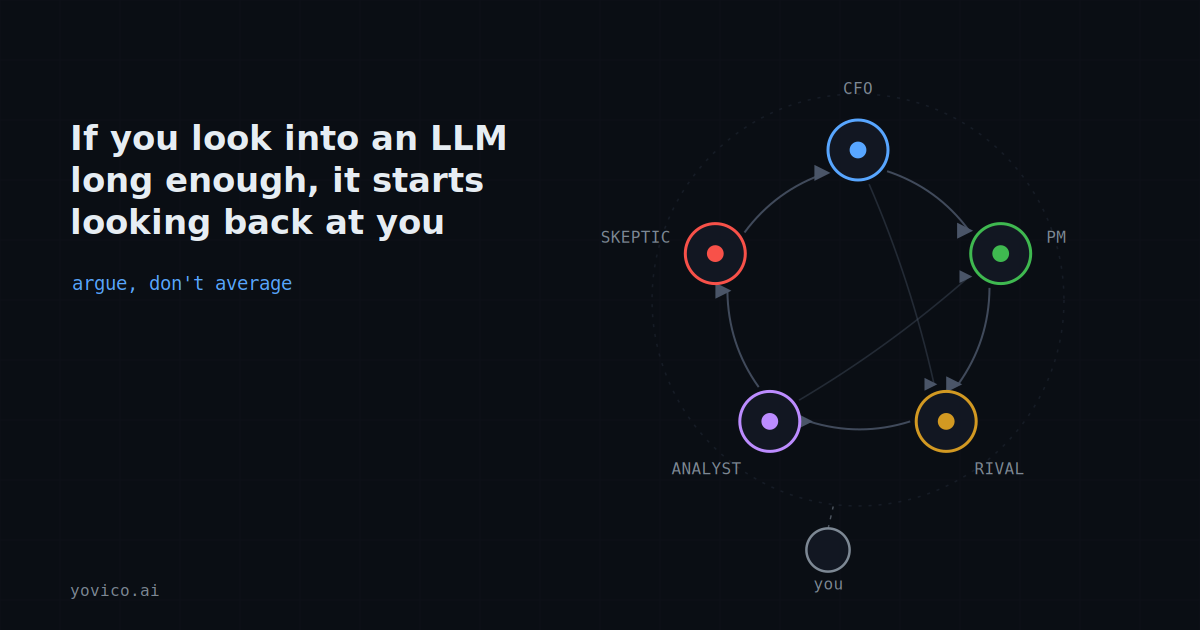
A dialogue is two voices. A polylog is many, and the difference is not just the headcount, it is multiple points of view. Give the room a set of personas that each hold a real frame. A CFO who sees cash and risk. A product manager who understands the product cycle and the trade-offs. A competitor looking for an opening in your armor. Not one chatbot agreeing with you. Different frames, each with its own priors, different domain knowledge and memories, perhaps different models from different vendors, and its own way of cutting the problem.
It is structurally more resilient, as the constructive disagreement is baked in, just like in real meetings.
This is not a just-so story, it is where the numbers point. Debate between model instances improves factuality and reasoning (Du et al., 2023). But the part that matters for a product is which ingredient does the work, and the answer is difference, not volume. In one head-to-head, three copies of the same model gained almost nothing from arguing with each other, while a set of different models gained a lot (Hegazy, 2024). Sameness in the room buys you close to nothing. Difference is the engine.
That is what "argue, don't average" means once you take it down to the mechanism. Averaging is what one surface does on its own. Arguing is what you get when you force several frames into the same room and refuse to collapse them into one.
You stop being the axis
One, the friction is on the page. In a single model, whatever weighing of the other side happens at all happens inside the box, and it comes out pre-averaged into one balanced answer. In the room, the conflict is visible, between named personas, and you can step into it and lean on the persona that is wrong instead of arguing with a fog.
Two, you are no longer the axis. In the dyad you look in and it looks back, and that is the whole trap. In the room the personas are looking at each other, not at you. You have been moved off the reflecting surface. The capacity that was quietly turning into you is spent holding frames apart, and there is none of it left over to average you.
Where the room fails
None of this is absolute, and it may fail in a specific way that is worth naming, because the failure is what most multi-agent demos are quietly doing.
Put weak personas in the room and they do not argue. They agree. This has been tried as early as late 2022. Sycophancy survives contact with other agents and then spreads between them, and small errors cascade through the group instead of getting caught (Too Polite to Disagree). Committees of models slide toward a shared position none of them examined. There is a name for it now, representational collapse. And a lot of the benefit people hand to debate turns out to be plain voting. Strip out the back-and-forth, just count the answers, and you recover most of the gain (Debate or Vote), which fits the broader finding that multi-agent debate often does not beat a single model running chain-of-thought (Stop Overvaluing Multi-Agent Debate). Talk is not automatically worth what it costs.
So more voices is not the key. Real frames is the key. A room of thin personas is validation theater with more mouths, and it is worse than talking to one model, because five things nodding along looks like consensus while one thing nodding along looks like exactly what it is. The engineering that matters is not spinning up more agents. It is designing frames that cannot just happily agree with each other, grounding them in domain knowledge and data, and that is most of the actual work behind Yovico.
The expensive model is the wrong model
Here is the part the papers have not caught up to, so take it as what we see in our own experiments rather than as something someone has proven.
Everyone assumes the strongest reasoning model makes the best persona. More "thinking" creates a better argument. That's not how it works in the room, and there is a clean reason for it.
The room is the reasoning. The chain of thought is not buried inside one model, it is spread across the personas as the argument you can read. Now drop a heavy reasoning model into one of the seats. It runs its own deliberation internally, before it speaks, and internal deliberation does one thing extremely well. It balances. It sees the other side, weighs it, and settles on the measured, hedged, on-one-hand answer. It pre-averages inside the box, which is the exact safe mean you built the room to escape. The reasoning model softens its own frame before the other personas get a word in. It sees their point too well and drifts to the center on its own.
So you pay twice. Once in latency and tokens for thinking it does in private that the room is already doing out loud. Once more in the pushback it softens away on its own. You do not want a model that sees all sides. You want one that picks a side and holds it, and lets the argument do the rest. A reasoning model reaches for the middle. In the meeting the middle is the wrong place to be.
The literature leans this way without quite landing on it. It says difference beats raw capability, and it doubts whether debate's gains come from deliberation at all. But nobody has written down that the reasoning model makes the worse debater. We see it in our runs.
There is a rhyme here with a side project I wrote up on my Substack. I trained a small non-reasoning classifier to catch prompt injection, and it beat a reasoning model at the same job, because a thing that reasons can be argued out of its verdict and a fixed classifier cannot. Same shape, different room. Here the non-reasoning persona beats the reasoning one because a thing that reasons averages itself out of its frame. When you need something that holds a position and cannot be talked or thought off it, reasoning is the problem, not the solution.
And non-reasoning models are cheaper!
Back to the abyss
The deepest mirror is the one that reasons best. The better a single chatbot model gets, the more convincingly it hands you back your own conclusion, and the harder it becomes to feel the reflection happening at all.
You do not beat that by finding a deeper model. You beat it by building a room that refuses to resolve too easily, full of things that are looking at each other instead of at you. That is Yovico. Not a better assistant. A room where you are not the center of the conversation, and nobody in it is working to make you comfortable.
The abyss only gazes back when there is one of it. Put several in a room, point them at each other, and they are too busy to look at you.